What is an RFI in construction?
By BuiltSum · Published · Updated
An RFI — request for information — is a numbered, dated question from the contractor to the architect or engineer asking what the contract documents mean. It exists because drawings conflict, details go missing, and the ground is never quite what the survey said. The answer clarifies the contract; it does not, by itself, change it.
When it is the right instrument
Use an RFI when the plans and the specification disagree, when a detail simply is not drawn, when a specified product has been discontinued, or when what you dug up differs from what was shown. Do not use one to ask for more time, to price a change, or to propose a substitution you have not yet documented — those are a schedule notice, a change order request, and a submittal respectively, and sending them as RFIs is why some contractors feel their questions vanish.
Who sends an RFI, and who answers it
The general contractor issues RFIs to the architect or engineer, and on most jobs a subcontractor’s question goes through the GC rather than straight to the designer, so the GC can check whether the answer is already in the documents and whether other trades are affected. The architect answers or routes it to the consultant whose drawing it concerns (structural, MEP, civil). Owners and construction managers sometimes issue them too, but the typical RFI starts with whoever is about to build the thing that isn’t clear.
What an RFI should contain
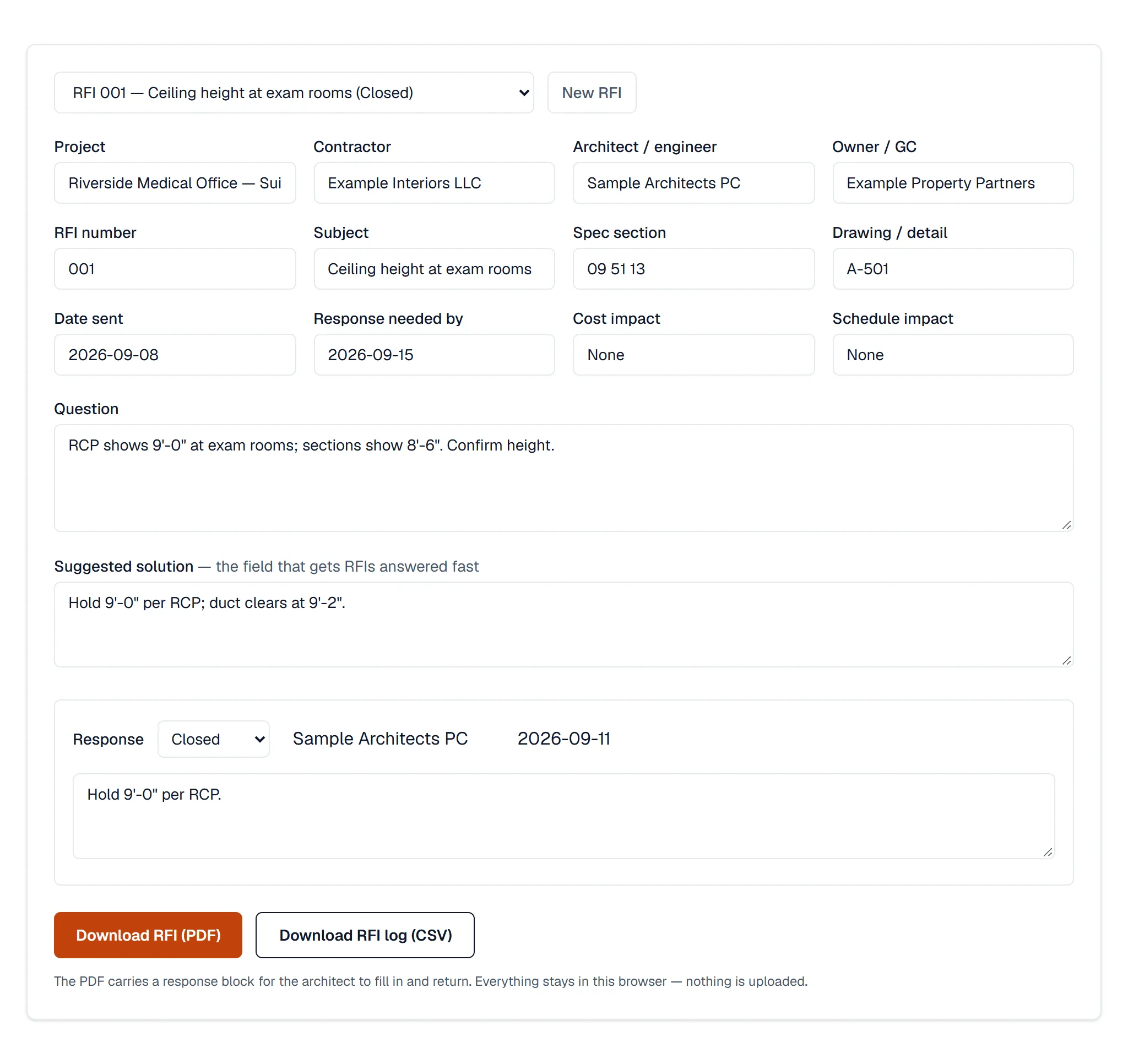
- A sequential number, date sent, and the date you need an answer by to avoid delay.
- The drawing sheet, detail and spec section in question, cited exactly.
- One question per RFI, with a photo or markup when a field condition is involved.
- Your proposed answer, and whether you expect a cost or schedule impact.
- A response block recording who answered, when, and any attachments.
RFI vs. RFP, RFQ and submittal
The acronyms share a first letter and little else. An RFI asks what the contract documents mean during construction. An RFP (request for proposal) and RFQ (request for quotation, or sometimes qualifications) are procurement documents, sent before a contract exists, asking firms to propose or price the work. A submittal asks for approval of what you intend to install. In procurement outside construction, “RFI” can also mean an early market survey before an RFP, which is why search results for the term are mixed.
How to write one that comes back fast
Ask a closed question and propose the answer. Compare: “Please clarify the corridor ceiling height” against “A-201 shows 9’-0” at corridor 1-04; the RCP on A-501 shows 8’-8”. We propose to proceed at 8’-8”, which clears the duct main, at no cost or schedule impact if confirmed by 1 September.” The second can be answered in one word by someone reading email on a phone. The first requires them to open two drawings and think.
The date is the asset
Months later, the question is rarely what the answer was — it is when it arrived and what it cost to wait. An RFI with a sent date, a required-by date and a dated response settles that in seconds. Keep them numbered and logged, with overdue responses visible, in the free RFI form generator.
When the answer adds work
The moment a response directs something beyond the bid scope, stop and write the change order — the generator takes a minute, and the RFI number is the reason line that makes it hard to argue with. The approved change then rolls into your next pay application instead of quietly becoming a loss.