What is retainage in construction?
By BuiltSum · Published · Updated
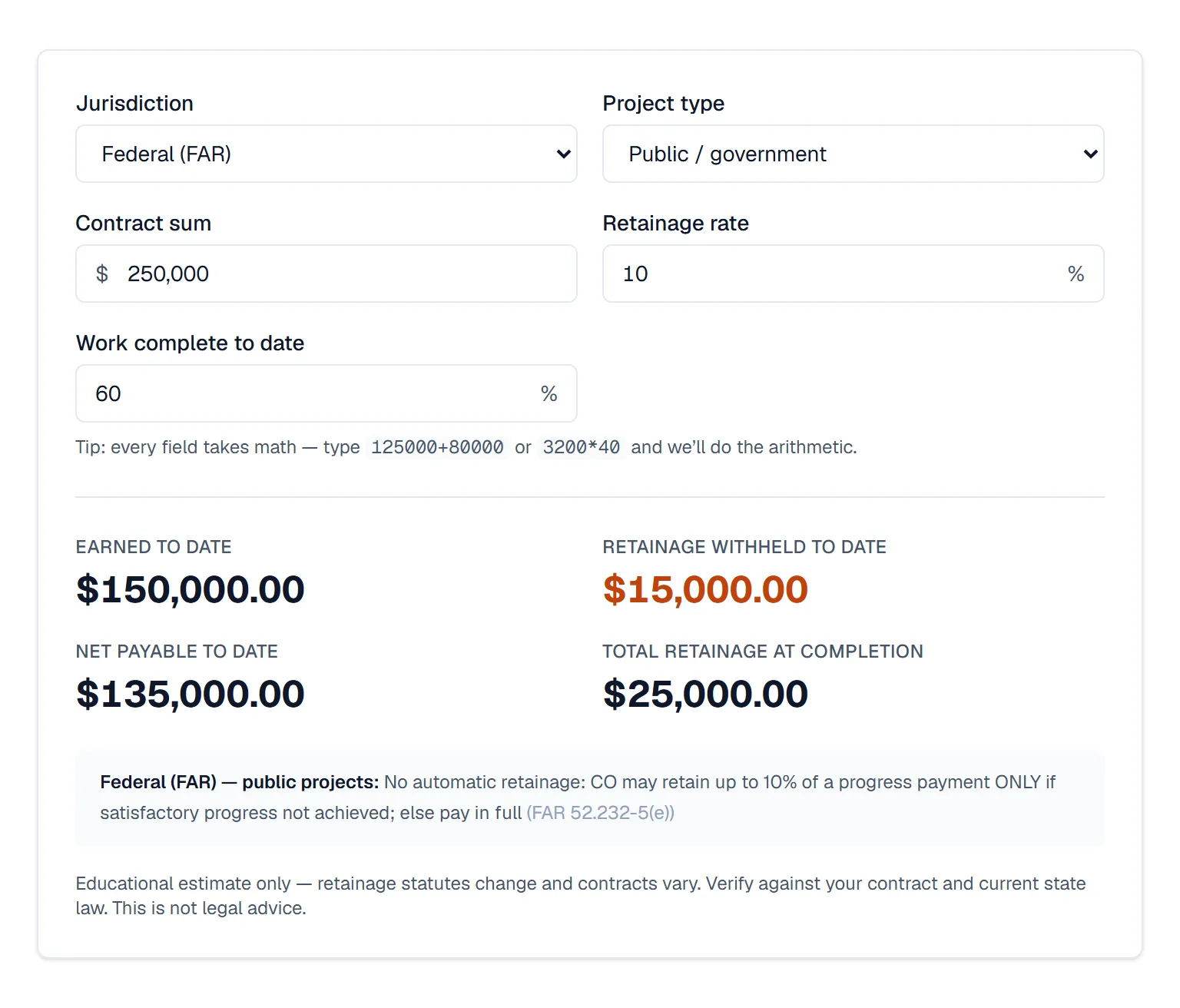
Retainage is the portion of each construction progress payment — typically 5% to 10% — that the owner or general contractor withholds until the work is complete and accepted. On a $250,000 contract with 10% retainage, a contractor who has earned $150,000 has $15,000 held back: money already earned, not yet payable. It exists to keep leverage for punch-list completion, and it is one of the largest silent drains on contractor cash flow.
How it works on a pay application
Retainage is computed on each period’s completed work (and often at a different rate on stored materials), accumulated line by line on the continuation sheet, and shown on the G702-style summary as line 5. It reduces “total earned” every month and is paid out at release — substantial completion, final acceptance, or a statutory deadline, whichever your contract and state law set. Because it compounds across periods, a small rate error in month two becomes a reconciliation problem by month six; keep it penny-exact per line.
State law caps the rate — sometimes
Retainage is regulated state by state, and the spread is wide: New Mexico prohibits retainage entirely; New Jersey caps public-project retainage at 2%; most states cap public work at 5–10%, often stepping down at 50% completion; and a growing list — New York, California, Washington, Colorado, Rhode Island among the recent movers — now caps private retainage at 5% on qualifying contracts. Federal work under FAR 52.232-5 allows up to 10% only when the contracting officer finds satisfactory progress lacking. The full table, with statutes and step-down rules, lives on our retainage calculator with 50-state law table.
Where subs lose the money
- No release calendar. Step-downs at 50% completion and statutory release deadlines go unclaimed because nobody tracks them. If your state drops retainage at halfway, bill the reduction the month you cross it.
- The final invoice never goes out. Retainage is released against a retainage application — an actual bill. Jobs close, crews move on, and 5% of the contract ages quietly in the GC’s liability column.
- Rate drift. A hand-built spreadsheet that applies 10% one month and 10% of a slightly different base the next produces the cents-off totals that get pay apps rejected — and every rejection is another 30 days of financing the job at 60–108 day DSOs.
Alternatives to cash retainage
Retainage is a negotiated term, and there are ways to keep the owner protected without the contractor financing it:
- Lower rate or step-down. 5% instead of 10%, or retainage stopped (not just reduced) once the job is 50% complete with satisfactory progress. This is the easiest ask, and many state statutes already require it on public work.
- Substituted securities or escrow. Several states let a contractor on public work deposit securities or use an escrow account in place of cash retainage, and keep the interest; California’s Public Contract Code §22300 is the best-known example.
- Retainage bond. A surety bond posted instead of cash withholding. Some public owners and private GCs accept one, which turns tied-up cash into a bond premium.
- Line-item release. Releasing retainage on a subcontractor’s scope when that scope is finished and accepted, instead of holding everyone’s money until the last trade finishes. Early trades such as sitework and concrete have the most to gain.
Managing it without a spreadsheet
Check any job’s withholding against your state cap with the free retainage calculator, and bill it monthly with the free pay application generator. BuiltSum goes further than accrual: it tracks release milestones, generates the final retainage invoice, and ages unreleased retainage so the 5% comes home.