BuiltSum for contractors
Contractor invoicing software: an invoice a general contractor will actually pay
Generic invoicing software assumes you sell a thing for a price. Construction bills a percentage of a schedule of values, minus retainage, plus approved changes, reconciled against every prior period — and gets sent back when any of that is a cent off. BuiltSum starts from the way construction actually gets paid, and because estimating and invoicing live in one place, the invoice bills the lines you estimated. That is the one thing contractor invoice software has to get right.
Two ways to bill, one set of numbers
Progress billing (commercial)
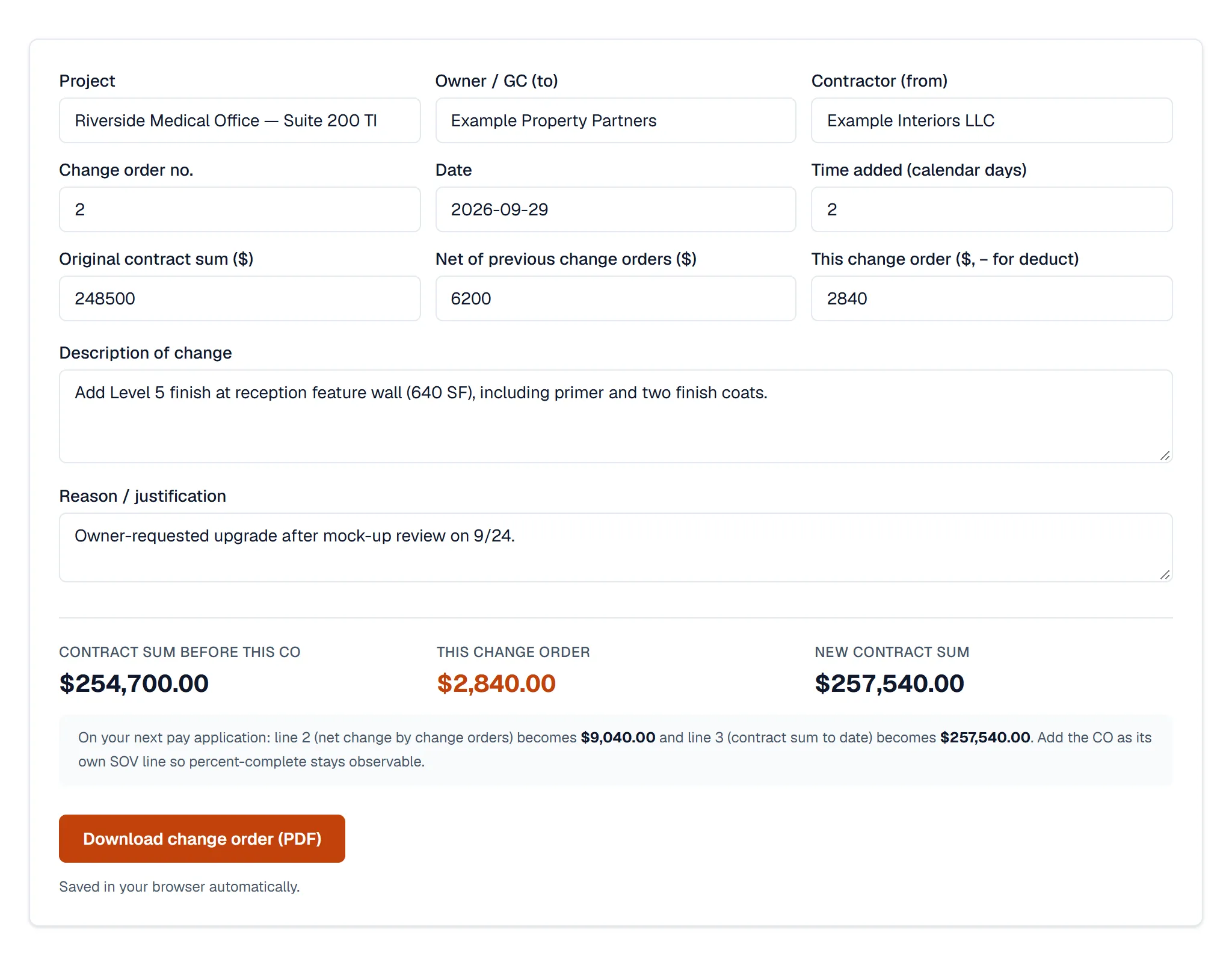
Bill each schedule-of-values line by percent complete, hold retainage per line, add stored materials, roll change orders in as their own lines, and carry previous certificates forward automatically. Output is an AIA-style G702/G703-style application with the continuation sheet attached.
Try the free pay application generator →Straight invoicing (residential & service)
For work that does not need a schedule of values, the accepted estimate becomes the invoice — same line items, same prices the client already agreed to, deposits and progress payments tracked against the contract total.
Start from an estimate →What a construction invoice needs that a generic one lacks
| Requirement | Generic invoicing app | BuiltSum |
|---|---|---|
| Bill % complete per SOV line | Manual line per invoice | Built in, sums checked to the contract |
| Retainage held per line | Not modelled | Per-line rate, running balance, release tracked |
| Stored materials | Not modelled | Separate column, its own retainage rate |
| Change orders | Extra invoice | New SOV lines, rolled into the contract sum |
| Prior periods reconciled | You keep the spreadsheet | Rolled forward, penny-exact |
| Architect certification | Not applicable | Shareable link with certification capture |
Keep your accounting where it is. The goal is not to replace QuickBooks — connect it, and each pay application lands there as an invoice instead of being retyped.
Frequently asked questions
Why not just use QuickBooks or a generic invoicing app?
Because a construction invoice is not a line and a total. It bills a percentage of each schedule-of-values line, withholds retainage at a rate that may differ for stored materials, carries approved change orders as their own lines, and has to reconcile against everything billed previously. Generic invoicing tools model none of that, which is why contractors who use them end up rebuilding the real math in a spreadsheet and typing the answer into the invoice.
Can I invoice a fixed-price job and a time-and-materials job in the same place?
Yes. Fixed-price work bills as progress against the schedule of values; smaller jobs bill as a straightforward invoice from the estimate. What matters is that both come from the same numbers you bid, so nothing is retyped between winning the work and getting paid for it.
Does it handle retainage?
Retainage is the point. It is withheld per line at your contract's rate, tracked as a running balance across every period, and released when the contract says — which most invoicing tools treat as a manual adjustment, if they acknowledge it at all. Held retainage is usually a contractor's single largest receivable, and it should never live only in someone's memory.
What about getting paid faster?
The two things that actually move payment dates are billing on time and billing correctly. A rejected pay application costs a full cycle — thirty days — so the arithmetic has to survive review, and the deadline has to be met without a weekend of Excel. That is what this is built for; card payment collection is not the bottleneck for commercial subs.
Bill the 20th without the weekend before it
Unlimited projects, AIA-style pay applications on every plan — from $49/mo.
Start free